
Shoshone Projected Versus Actual Release
A projected date is a calculation or conditional milestone. An actual release is a completed custody event. Idaho records add two other milestones: parole eligibility, when the Commission may first consider release, and sentence satisfaction, when IDOC jurisdiction ends. A person can leave prison for parole before the sentence-satisfaction date and remain supervised.
Pretrial custody works differently. There is no sentence to calculate. Bond, dismissal, charging choices, a judge’s order, warrants, or a detainer may control when the person leaves Shoshone County Jail. A detainer is a hold or request from another authority. Departure can also be a transfer rather than community release.
Find Shoshone Projected Release Dates
Start by deciding whether the person is held on a local case, serving a county-jail term, or under IDOC jurisdiction. The same name can appear in more than one system. IDOC’s Resident/Client Search accepts a last name, first name, or IDOC number and warns that data generally updates once daily.
- Search IDOC and match the name, birth year, IDOC number, sentencing county, and case number.
- Read each case row and preserve its exact label, including Parole Eligibility Date, Released to Supervision, and Sentence Satisfaction Date.
- Check the Commission decision notices for a tentative parole action, without treating it as release.
- For a county-jail term, request the computed event and credited time from Shoshone County Jail and obtain the judgment through iCourt or the clerk.
- Ask about warrants, detainers, consecutive terms, and corrected judgments before relying on a date.
The broader Shoshone County release record path explains how to distinguish a sheriff custody event from IDOC discharge.
Idaho Fixed Terms Shape Release
Idaho does not use a general 85 percent rule. Under Idaho Code § 19-2513, a unified sentence has a fixed or minimum part and, when imposed, an indeterminate part. Ordinary parole and routine good-conduct reduction do not shorten the fixed term. Parole consideration begins in the indeterminate portion.
A sentence stated as three years fixed plus seven years indeterminate ordinarily reaches parole eligibility after the fixed part, subject to lawful jail credit and case-specific calculation. It does not promise release at that point or after 85 percent of the maximum. Mandatory minimums, enhancements, consecutive fixed portions, forfeiture after parole action, and corrections to the judgment may alter the sequence.
Section 20-101D is not ordinary good time. It permits a limited possible reduction for an extraordinary act of heroism or outstanding service described by the statute. It creates no routine entitlement and an award may be withdrawn under applicable rules.
The official IDOC Sentencing Records page identifies the unit responsible for sentence computations.
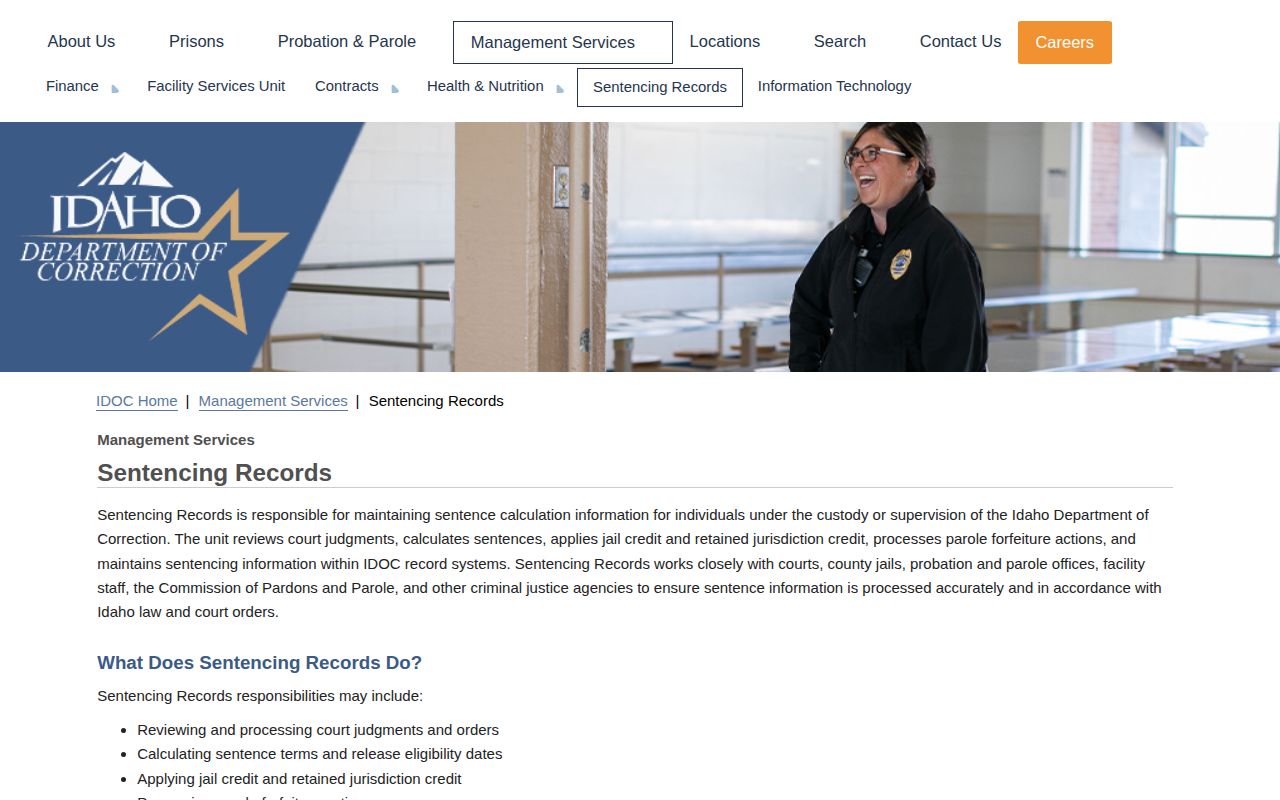
This records route is the proper source for an IDOC calculation question, while the county judgment controls a short local term.
Why Shoshone Release Dates Change
A public date may move because its underlying legal or administrative facts changed. A tentative parole date is especially conditional. Required programs, an approved parole plan, and final paperwork must be complete before actual release.
| Factor | Effect on the date |
|---|---|
| Sentence credit | Lawful jail credit changes the calculated sequence |
| Consecutive terms or enhancements | Additional fixed portions can delay eligibility |
| Commission action | Parole may be granted, denied, reviewed, or later revoked |
| Programming or plan approval | Unfinished prerequisites can delay a tentative date |
| Detainer or warrant | Another authority may take custody even when one term ends |
| Corrected judgment or records | A lawful correction changes the computation |
Note: A person transferred from Shoshone County Jail to IDOC has left the jail but has not been released to the community.
Confirm Shoshone Release Dates
VINE can provide a custody-event alert, but the custodian confirms actual release. Register through the Shoshone County VINELink check for a matched in-custody record. After an alert, ask the sheriff whether the local event was bond, time served, court order, or transfer. For a state prisoner, recheck IDOC for In community and Released to Supervision.
Do not collapse later discharge into the first prison-exit date. IDOC may display a sentence-satisfaction date well after parole begins. Commission notices also mark dates as tentative. When records conflict, preserve each label and seek the computation from Sentencing Records rather than selecting the earliest date.
Four Shoshone Release Milestones
Idaho’s sequence is unusually important for Shoshone cases. First comes the end of the fixed term and parole eligibility. Second may come a tentative Commission date. Third is actual release to supervision after prerequisites are met. Fourth is discharge or sentence satisfaction, when IDOC jurisdiction ends.
The Commission may release an eligible person later or not at all. A fixed-only sentence does not create parole merely because a portal uses projected-date language. For a county term, no researched Shoshone source publishes a county good-time formula, weekend-release rule, or automatic Friday adjustment. Those rules must not be borrowed from another county.
Note: Eligibility, tentative action, release to supervision, and discharge are distinct milestones with different records and legal effects.
Read Shoshone IDOC Date Fields
IDOC search results begin with an IDOC number, name, birth year, and broad status. Open the detail before interpreting a date. Active records can show age, location or supervising district, an assigned officer and phone when applicable, offense rows, sentencing county, case number, Released to Supervision, Sentence Satisfaction Date, and sometimes Parole Eligibility Date or a next hearing. Not every field appears on every record.
Parole Eligibility Date is the earliest point for Commission consideration after the controlling fixed portion. It is not a scheduled exit. Tentative Parole Date reflects conditional Commission action. Released to Supervision is retrospective evidence that a parole or probation placement occurred. Sentence Satisfaction Date marks the sentence end. A Discharged detail may suppress old offense information while retaining the discharge date.
The public search generally updates daily, not in real time. Preserve the label, date viewed, IDOC number, and case row when a calculation matters. If the visible fields do not resolve the sequence, request the computation through IDOC Sentencing Records or its public-records portal. Do not infer a missing date from the maximum sentence alone.
The captured IDOC in-custody example shows how a parole eligibility field appears on a live detail.
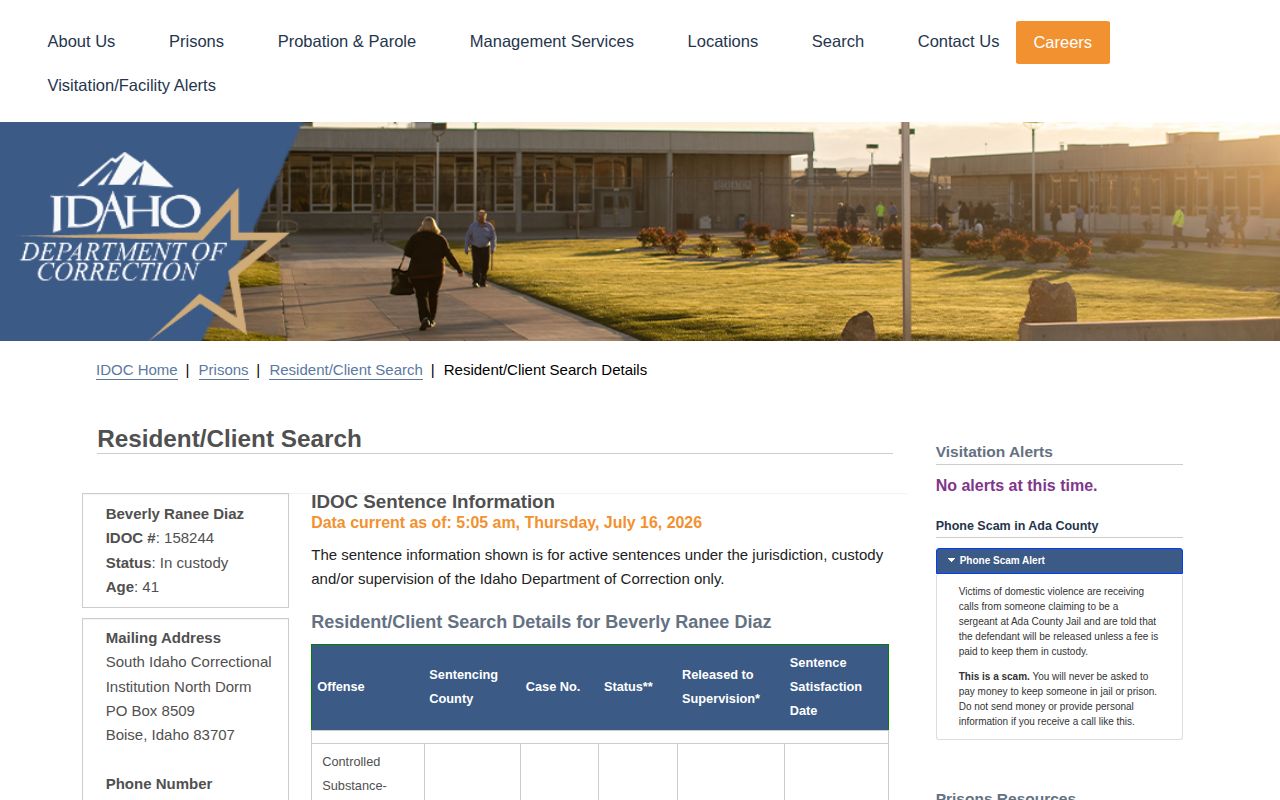
The example supports reading the field as eligibility, not as a guaranteed release appointment.
Shoshone County Jail Date Calculations
Do not apply IDOC parole fields to a short county-jail sentence. The local judgment and jail computation control. Ask Shoshone County Jail for the computed release event, time credited, custody-event history, and any transfer destination. Obtain the public judgment and later orders through iCourt or the county clerk so the jail response can be checked against the court’s authority.
No authoritative Shoshone source reviewed publishes a county good-time formula, weekend-release law, or automatic Friday adjustment. A projected calculator based on another county would therefore invent a local rule. The same caution applies to a pretrial detainee. Without a sentence, there is no fixed-plus-indeterminate calculation. Bond, dismissal, warrants, charging action, a court order, and holds determine the next step.
Shoshone’s local custody context makes transfer especially significant. County minutes described many state inmates waiting at the jail for IDOC transport. A name leaving the local jail can mean delayed transport finally occurred. Ask whether the person entered the community or moved to another custodian, and check IDOC after a state transfer.
Shoshone Tentative Parole Dates
The Commission’s hearing calendar shows a scheduled proceeding, not release. Its decision notice may later grant a tentative date, deny parole, set review, or record another disposition. The Commission states that programming, IDOC approval of the parole plan, and final paperwork must be complete before release. Dates and hearing orders may change.
Parole is discretionary during the indeterminate part of an Idaho unified sentence. Eligibility creates no presumption or right to release. Under IDAPA 50.01.01.250, the Commission may release on or after eligibility or may decline to do so. Fixed-only terms, mandatory minimums, enhancements, consecutive sentences, and other case-specific rules require the actual judgment and IDOC calculation.
Once the tentative date passes, look for the IDOC status and Released to Supervision field rather than relying on the decision notice. If the person remains in custody, unfinished prerequisites, a rejected plan, a detainer, corrected sentence data, or later Commission action may explain the difference. Contact the responsible agency for the current reason.
A hearing date, decision date, and release date answer different questions. The hearing date marks the proceeding. The notice records the Commission’s action. The release field documents that the person actually entered supervision. Keeping those dates separate prevents a favorable decision from being reported as a completed prison exit.
Supporters who plan to participate in a parole hearing must follow Commission procedures. The research states that incarcerated people attend virtually while supporters and the public attend at the Boise office, and a supporter wishing to testify must give advance notice. Hearing logistics can change, so use the current Commission calendar rather than an old date saved from a search result.
After release to supervision, the sentence still runs. IDOC may list the assigned district or officer and later post sentence satisfaction or discharge. That final date should not replace the earlier Released to Supervision date in a release history. One records community placement; the other records the end of jurisdiction.
Medical parole under Idaho Code § 20-1006 and an extraordinary meritorious reduction under § 20-101D are narrow exceptions, not ordinary ways to estimate a projected date. Neither supports a general percentage formula. A reliable answer remains tied to the judgment, lawful credits, IDOC computation, Commission action, and actual custody event.
Multiple sentences require added care. The Commission FAQ explains that eligibility for a modern unified sentence follows satisfaction of the fixed or determinate portion, and the controlling point for multiple sentences can depend on how the terms run. Concurrent terms overlap, while consecutive terms follow one another. Enhancements and mandatory minimums can add fixed time. A public maximum date alone does not reveal that sequencing.
Records can also be corrected. An amended judgment, newly applied jail credit, or a correction in sentence data may change a displayed date without any new parole decision. Preserve the older result only as a dated snapshot. The current judgment and IDOC calculation control. If the explanation is not visible, ask Sentencing Records for the calculation basis and identify the exact case number and IDOC number.