
Understanding Shoshone County Releases
A release is an event recorded by a particular custodian. At Shoshone County Jail, it may mean bond, dismissal, time served, completion of a county term, probation, or another court-authorized return to the community. It may instead mean transport to the Idaho Department of Correction, another jail, federal custody, or an agency acting on a hold. Those results are not interchangeable. The sheriff's custody-event history is the best local record because it can tie the event to one booking and identify whether the person went to the community or another authority.
State records use different terms. An IDOC result marked In community describes a corrections category, often probation or parole, but it does not guarantee the person is physically outside a jail. Discharged means IDOC jurisdiction ended on the stated date. A person may have left prison long before that discharge. Court records explain the legal order, while VINE reports a status event. Neither replaces the custodian's own release record.
The agency named in a result sets the scope of the answer. Release from BOP means departure from federal Bureau of Prisons custody. Release from ICE means departure from ICE custody. A county jail transfer means the county no longer holds the person, but another agency may. Precise wording prevents a true fact about one system from becoming a false claim about all custody. When records conflict, compare their update times and call the agency that appears to hold the person most recently. Keep the date and source with each conclusion.
- Time served
- A release after the custodial part of a sentence has been completed or credited.
- Transfer
- Movement to another custodian, not release to the community.
- Parole
- Conditional release during the indeterminate part of a state prison sentence.
- Discharge
- The end of IDOC jurisdiction after the sentence is satisfied.
Shoshone County Release Paths
The next source depends on the kind of exit. Ask for the event type, effective date and time, authority, and destination. A simple answer that someone is “gone” does not settle whether the person left custody or merely left the building.
| Event | What it means | Best next check |
|---|---|---|
| Bond, dismissal, or court order | The jail processes a community release under legal authority. | Sheriff custody history and the matching iCourt order |
| County time served | The local custodial term has ended. | Release event plus judgment and credit entries |
| Probation | The court places the person under community supervision. | iCourt judgment and IDOC sentence row |
| Parole | The Commission conditionally releases a state prisoner. | IDOC parole row and Released to Supervision date |
| IDOC or agency transfer | The person remains in custody under a new authority. | Destination in the jail event, then the receiving system |
Note: A roster disappearance is not proof of community release because current rosters are not designed as historical release archives.
A detainer is a request or legal basis for another authority to take custody when the first agency's hold ends. It can change where a person goes even after bond is posted or a county sentence ends. The county event should therefore be read with the court file and any receiving-agency record. The phrase “released on bond” may accurately describe the local charge yet still fail to describe the person's physical destination when another valid hold remains.
Shoshone County Release Record Fields
Shoshone County does not publish a public interface that confirms its jail-system labels. The safe approach is to request fields rather than claim they appear online. A narrow request should identify one person and booking, then ask for the custody event and its disposition. This helps distinguish namesakes and keeps the search tied to a defined date range.
| Requested field | What it can show |
|---|---|
| Booking number and date | The jail episode linked to the release |
| Arresting agency, charge, case | The legal matter tied to custody |
| Release date and time | When the recorded event took effect |
| Release event or type | Bond, court order, time served, transfer, or another disposition |
| Releasing authority | The court, jail, or agency controlling the event |
| Destination or transfer agency | Community release versus continued custody elsewhere |
| Custody-event history | Movement and status changes within the booking |
A court judgment may explain why release was authorized, but it may not show the precise door-exit time. IDOC's Released to Supervision field can document a probation or parole placement, while Sentence Satisfaction Date describes the expected or actual end of the state sentence. Read the sentence-row status with both fields.
Older state details can become less specific after discharge. IDOC keeps the person's identity, number, age, status, and discharge date while suppressing old conviction detail in the inspected example. That design makes the portal useful for confirming the end of IDOC jurisdiction, but it also means the Shoshone case number and court record may be needed to connect the state result to the correct conviction. A public record that lacks an offense row is not necessarily incomplete; it may reflect the state's published treatment of satisfied sentences.
Request Shoshone County Release Records
Use the county's documents and forms page and current public-records form. Identify the Sheriff's Office/911 department and complete the sheriff addendum. The form permits email, mail, pickup, or in-person examination. It also asks for the Idaho residency declaration required by the cited records law.
- Gather the full name, distinguishing birth information, approximate booking date, and any case or booking number.
- Name the booking summary, custody-event history, release date and time, release type or destination, and photo if disclosable.
- Ask the sheriff to distinguish community release from transfer to IDOC or another agency.
- Choose a delivery method and ask for an advance cost estimate before work that may incur a charge.
- Keep the response and compare any court-order reference with the filing in iCourt.
700 Bank Street
Wallace, ID 83873
208-752-3331
bocc@co.shoshone.id.us
The county does not promise that every requested field or photograph is public. Investigatory and protected material may be withheld or redacted. If the response is only “released,” ask for the event type or destination. If it says “transported,” do not recast it as freedom.
A focused description gives the custodian a realistic search. State the approximate booking date and use a short date range. Ask first for the booking summary and movement or release entries when a broad request draws a scope concern. A photo can be requested separately if review of that item would delay the event record. Electronic delivery and an advance estimate may reduce surprises, but the research supports no promise that a photograph exists, will be disclosed, or carries a fixed fee.
For an IDOC record, use the agency's JustFOIA portal and include the IDOC number, sentencing county, case number, and exact record sought. A release or transfer movement, sentence calculation, parole documentation, satisfaction record, discharge record, or latest identification photo are distinct items. Commission records such as a Notice of Action Taken or retained review material use the Commission's public-information route, not its general contact form.
Idaho Rules for Shoshone Records
Idaho's Public Records Act is Title 74, chapter 1. The Idaho Attorney General's records guidance says requests go to the designated custodian. For an Idaho resident, an agency generally grants or denies a request within three working days. If more time is needed, it can extend to ten working days. The first two labor hours and first 100 paper pages are generally provided without charge to Idaho residents, while added work may be billed at the lowest-paid qualified rate.
Court files follow Idaho Court Administrative Rule 32, not the Public Records Act. Retention under Rule 38 does not guarantee public access. Juvenile, sealed, shielded, presentence, and other protected material may remain unavailable. Idaho Clean Slate relief shields eligible records from public disclosure after a court grants relief; it does not destroy the historic custody event.
Rule 38 also separates preservation from public display. Conviction-linked records cannot be destroyed while the person remains incarcerated, on court-ordered probation or rehabilitation, or on parole for that conviction. After supervision ends, retention depends on the rule and appeal timing, while essential items such as the register of actions, charging instrument, judgments, and minutes remain among preserved materials when a file is otherwise eligible for destruction. Access can still be limited by another rule or court order.
If a county request is denied or partly denied, read the written reason and retain the request and response dates. The county form identifies an appeal route, though no result is guaranteed. A current investigatory exemption may restrict a jail document while a nonexempt status or public docket entry remains available. The lawful response is to narrow the request or follow the stated review process, not to infer missing facts from an inaccessible file.
Shoshone Jail Transfer Backlog
Official March 2025 county minutes recorded a jail population of 55 to 56, including about 23 state inmates awaiting transport. One wait was reported at nearly 1,000 days. The minutes also discussed IDOC reimbursement of $75 per day against a county estimate near $100 per day. These figures describe a specific meeting record, not a current population count.
The local effect is important. A state-sentenced person can remain at Shoshone County Jail long after commitment and later disappear from the local building through transport. That change is entry into state custody, not a community release. Ask for the receiving agency, then use IDOC's physical-location and sentence fields.
Find Released Shoshone County Inmates
Start with the last known custodian. Shoshone County has no discoverable official current roster or recent-release feed, so a phone check and targeted request lead the local path. The statewide and federal systems answer different questions.
- Record the name, birth year, approximate booking date, and any case, booking, IDOC, BOP, or A-number.
- Call the Shoshone County Sheriff at 208-556-1114. Ask whether the event was community release or transfer, its effective time, and the controlling authority.
- Search Idaho iCourt for the Shoshone case. Read bond, dismissal, judgment, probation, commitment, and later discharge entries.
- Search the IDOC Resident/Client Search when a state sentence or adult supervision may apply.
- Use VINELink for a specific participating Idaho custody record and notifications, then confirm an event with its source agency.
- For federal custody use BOP. For ICE custody use its detainee locator. A USMS pretrial history may require the federal docket and a focused records request.
A current phone answer is useful when timing matters, but a written event record supplies the documentary trail. Search iCourt by exact case when possible, because similar names can point to unrelated matters. A judgment can precede jail processing, and an IDOC update can follow transport. Record the source and its data-current time rather than forcing records from different systems into a single timestamp.
If a state result says In community, open the detail. Review physical location, supervising district, officer contact if shown, each sentence row, Released to Supervision, Sentence Satisfaction Date, and any parole eligibility or hearing fields. If a federal result says released, check whether a state, county, supervision, or ICE matter remains. The goal is a system-specific statement such as “IDOC lists the sentence discharged on the shown date,” not the broader and often unsupported claim that a person is free.
Names and dates should be matched with care. A birth year, booking number, case number, or corrections number helps separate people with similar names. Do not publish unneeded personal identifiers while doing that work. When the public result supplies only a year of birth, use it as one matching point rather than conclusive identity. The Idaho registry itself warns that name and birth information are not positive identification, which is a useful caution for every public portal.
IDOC Search for Shoshone Releases
IDOC calls its tool Resident/Client Search and expressly keeps people who served time and satisfied their sentence in results, though old conviction details are suppressed. Search by last name with optional first name, or by IDOC number. Partial last names need at least two characters, while partial IDOC numbers need at least three digits.
| Field or status | How to read it |
|---|---|
| IDOC number | The strongest public identifier for a state record |
| In custody | Current IDOC custody, not a state-prison release |
| In community | A community-side category that can coexist with a jail location |
| Discharged with date | The sentence is satisfied and IDOC jurisdiction ended |
| Released to Supervision | The most recent probation or parole placement, read with row status |
| Physical location | Where the person is listed, which may differ from overall status |
The official IDOC search form shows the fields available for a name or number lookup.
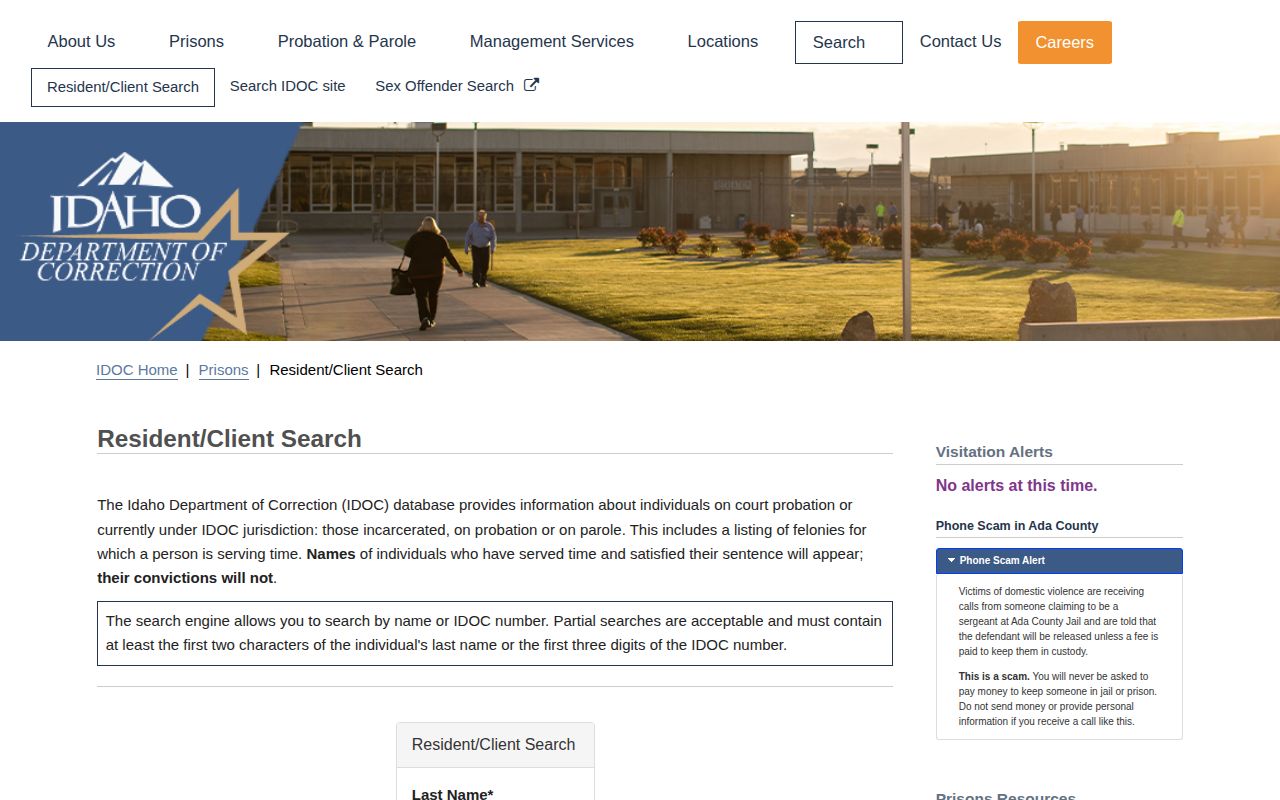
The form is the correct statewide route after a Shoshone sentence or transfer, but IDOC warns that rapidly changing data may lag.
Two official Shoshone-linked examples show why the detail matters. One parole result combines overall In community, a parole sentence row, a Released to Supervision date, and a later Sentence Satisfaction Date. That combination supports release to parole while the sentence continues. Another result combines In community with Shoshone County Jail as the current physical location. The second record is a direct warning against translating a broad corrections category into a statement about where the person is standing now.
A Parole Eligibility Date is not a promise of release. It marks a point at which parole consideration may occur under the sentence. A hearing schedule means a review is planned. A favorable decision can remain tentative while prerequisites, placement, detainers, and paperwork are resolved. Actual release to supervision is best checked later in the IDOC detail, while final discharge is shown only when the state sentence and jurisdiction end.
Shoshone County Recent Release Checks
No official Shoshone County 24-hour or 72-hour release interface was found. The sheriff page provides contact and a records-request route, but no verified feed window, cadence, retention period, field list, photo gallery, or official mobile app. The practical check is a call with a defined time range, followed by a written custody-event request and iCourt review.
Local booking-news columns are only leads. They may give an approximate booking date, but they describe arrests, not releases, and often use an agency logo instead of an individual photo. The Shoshone County 24-hour release page explains the same-day fallback without presenting news as an official feed.
For a same-day question, ask whether the person left during the prior 24 hours and request the effective event time. For a weekend or holiday question, give the exact three-day range. A wider date range catches uncertainty but does not create a feed. VINE may report an event after the jail system changes, and iCourt may post an order before physical processing ends. The sheriff remains the source for whether the event was release, transport, or another custody movement.
Shoshone County Release Supervision
IDOC supervises both probation and parole. Probation is imposed by the district court after a sentence is suspended. Parole is conditional release granted by the Commission during the indeterminate portion of a prison sentence. Verify the difference through the sentence-row status, not the overall In community label alone.
Shoshone County is served by IDOC Probation and Parole District 1 in Coeur d'Alene. That office also covers Benewah, Bonner, Boundary, and Kootenai counties. No Shoshone satellite is listed. An IDOC detail may show the assigned district, officer, and phone, though staff may limit personal information. A current result is more specific than a generic office directory.
A supervision status does not prevent a new arrest or sanction. Someone can remain in IDOC's community category while physically lodged at Shoshone County Jail. An Active Bench Warrant, Probation Violator, or Parole Violator label also needs agency confirmation. IDOC Fugitive Recovery publishes a selective Most Wanted list, not a complete list of every absconder or warrant. Resident/Client Search is the broader first check.
Shoshone Release Alerts and Federal Records
Idaho VINE provides custody notifications for participating Idaho prison and jail data. Search one person, compare the reporting facility and identifiers, and register an available phone, text, or email method. A release alert reports a change from that agency. It may not provide the exact type, time, destination, or a permanent history. Confirm it with the sheriff or IDOC.
The BOP locator covers federal inmates from 1982 forward and can show a release date or “Not in BOP custody.” That proves exit from BOP only. ICE's locator includes current custody and people released from ICE custody within its prior 60-day scope. USMS has no comparable public historical locator for federal pretrial prisoners, so use the federal docket and an agency request.
For BOP, search by register or other federal number when known, or use a name with the available demographic filters. The public result can show name, register number, age, race, sex, release date, and location or status. ICE requires a nine-digit A-number with country of birth for that search method, or exact first and last names with country of birth for a biographical search. Its public locator excludes records for people under 18.
A federal defendant may spend pretrial time in a local or regional facility under USMS authority and later enter BOP custody after sentencing. USMS manages those movements but does not expose a comparable public release-history tool. The federal docket may show bond, acquittal, commitment, or another order. A focused USMS Freedom of Information Act request can seek an agency disposition record, subject to exemptions.
The Idaho Central Sex Offender Registry is a separate system for people with a statutory registration duty. It supports name, city, county, ZIP, and map searches, including Shoshone County. A registry entry can show that a person is living in the community or has a listed compliance status, but it is not a general released-inmate list. It does not prove the date, reason, or custodian involved in release. Use it only when the specific registration duty is relevant.
Compare Shoshone Release Sources
Each system proves only its own event. Combine the strongest record with a second source that explains authority or destination.
| Known custody | Release evidence | Second check |
|---|---|---|
| Shoshone County Jail | Custody event says community release with date, type, and authority | iCourt order and any receiving-agency check |
| IDOC sentence | Parole row plus Released to Supervision, or Discharged status | Physical location and Commission action |
| Federal BOP | Released or Not in BOP custody with date | Federal docket and other custody systems |
| ICE | A released match within official locator scope | Immigration case and any criminal custodian |
Shoshone County Release Facilities
Shoshone County Jail is the adult county facility. Its release may lead to the community, IDOC, another jail, or another authority. Confirm the custody event and destination. The jail remained open during a documented spring 2026 “soft closure.” That phrase reflected operational limits and did not mean every person was released or that the facility closed.
Kootenai County Juvenile Detention Center is a regional juvenile facility serving Shoshone County by agreement. Juvenile custody is outside an adult released-inmate search. Adult IDOC tools, jail booking columns, and adult records paths should not be used as substitutes for the responsible juvenile court or facility's lawful process.
No operating IDOC prison, federal prison, or dedicated ICE detention center was found within Shoshone County. That does not remove those systems from a Shoshone case. A state sentence can be served wherever IDOC assigns the person. A federal pretrial prisoner may be housed under USMS authority outside a federal prison, and an immigration transfer follows its own locator and case process. Facility location and legal custody must be checked separately.
Shoshone Release Orders and iCourt
A court order and a jail release record answer different parts of the question. iCourt may show bond, dismissal, probation, commitment, an amended judgment, or a later discharge. The jail event records when custody processing occurred. A state commitment can explain why a name left local custody through transport instead of release.
Use the Idaho court records guidance to obtain a document through the clerk or courthouse kiosk when the online register is not enough. Shoshone County Magistrate Court handles misdemeanors and felony preliminary matters, while serious cases proceed in District Court. Protected and sealed records remain subject to separate access rules.
Shoshone Diversion and Release Proof
Shoshone County's Integrated Law Enforcement Diversion initiative links law enforcement, service providers, prosecutors, and a jail case manager. Its program material contemplates discharge summaries. Treatment Court adds another local path through the justice system. These programs can explain why a case moves away from ordinary prosecution or detention, but neither is a released-inmate locator.
A program discharge is not automatically the same as physical discharge from jail. Confirm the actual custody event through the sheriff and the legal change through iCourt. This distinction also protects against reading a treatment placement, probation order, or program exit as a new jail release when the dates and authorities do not match.
Resolve Shoshone Release Conflicts
Different systems can be correct at different moments. A court may enter a bond or dismissal order before jail staff complete identity, property, paperwork, and hold checks. VINE can receive an event after the jail records it. IDOC says its public information updates daily, so a transport or location change may not appear at once. A newspaper booking item can remain online long after the custody event changes.
Write down the time attached to each source and the precise system it describes. Then call the current custodian. If documentary confirmation matters, request the underlying event rather than relying on a screen capture alone. A clear conclusion names the source, event, and date. It avoids broad language about freedom when a transfer, detainer, supervision term, or later arrest may still affect the person.
Shoshone Discharge and Record Retention
Physical release, supervision release, and legal discharge occur at different points. A person may leave a jail after bond while the criminal case remains open. A state prisoner may enter parole and live in the community while the IDOC sentence continues. Final IDOC discharge comes when the sentence is satisfied and state corrections jurisdiction ends. The public detail inspected for a discharged person kept identity and discharge information but suppressed the old conviction detail.
Court retention follows its own schedule. Rule 38 protects conviction-linked records from destruction while incarceration, court-ordered probation or rehabilitation, or parole continues for that conviction. Later, core items may be preserved even when other file material reaches its retention point. Public access remains a separate question under Rule 32, sealing orders, juvenile rules, and Clean Slate shielding.
A missing public result therefore has several possible explanations. It may reflect a name mismatch, transfer, update lag, a live system's retention limit, protected access, or the end of one agency's jurisdiction. It does not prove that no custody event occurred. The originating jail, corrections agency, or court file remains the route for a specific historical record.
Clean Slate shielding is not erasure. Idaho's official process generally requires completion of the entire sentence and a waiting period, along with offense and later-history limits. If relief is granted, public disclosure changes while specified official access remains. A shielded court case cannot be treated as proof that the earlier jail booking or release never happened. The historical event and the current public view are two different facts.
Search Public Records
Sponsored Results