
Shoshone Parole and Probation
Both forms of supervision are administered through the Idaho Department of Correction, but they begin in different ways. Parole is a conditional move from prison into the community during the indeterminate part of an Idaho sentence. Probation is imposed by a court, often instead of prison or after a retained-jurisdiction decision. A person can also be released from Shoshone County Jail with neither status. Bond, dismissal, time served, transfer, and an ordinary court order are separate custody events.
The public IDOC detail is the best first comparison point. Read the individual case row, not just the broad status at the top. A row labeled Parole identifies parole supervision. A row labeled Probation identifies probation. “Released to Supervision” records the start of that placement, while “Sentence Satisfaction Date” concerns the end of the sentence. These dates can differ by years.
| Point | Parole | Probation |
|---|---|---|
| How it begins | Commission grants conditional community placement after parole eligibility | Court orders community supervision |
| Public clue | IDOC case row says Parole | IDOC case row says Probation |
| Custody history | Usually follows prison custody | May follow jail, retained jurisdiction, or a direct court sentence |
| End point | Discharge or sentence satisfaction after supervision | Court or IDOC discharge when the term ends |
- Discharge
- The end of correctional jurisdiction, not merely the date a person walked out of a facility.
- Absconder
- A supervised person alleged to have stopped reporting or left supervision without authorization.
- Detainer
- A request or hold from another authority that may affect custody or release.
Verify Shoshone Post-Release Supervision
The IDOC Resident/Client Search accepts a name or IDOC number. Its results can show In custody, In community, Discharged with a date, or Active Bench Warrant. Those are IDOC categories. “In community” is not proof of a home address, and research found an IDOC example that paired that status with Shoshone County Jail as the listed location.
- Search the full legal name and try reasonable name variants. An IDOC number is more precise when known.
- Compare the birth year, middle name, IDOC number, and case details before selecting a result.
- Open the detail and read each offense row. Identify whether its status says Parole or Probation.
- Record the supervising district, assigned officer, and district phone when those fields appear.
- Confirm a current status with the listed office. Use the court file for the probation order and Commission material for parole action.
An IDOC page can change as records are updated. For a durable record or a sentence-calculation question, use the IDOC public-records portal. The Shoshone County released-inmate search on the home page explains when the sheriff record and iCourt case should be checked as well.
Shoshone Supervision Through District 1
Shoshone County is assigned to IDOC District 1. The official page lists the Coeur d’Alene office and does not list a Shoshone County satellite. The individual IDOC detail is often more useful than a general directory because it may name the assigned officer and show a direct district phone.
IDOC District 1 Probation and Parole202 Anton Avenue
Coeur d’Alene, ID 83815
208-769-1444
The official District 1 office page is the source for the regional supervision contact.
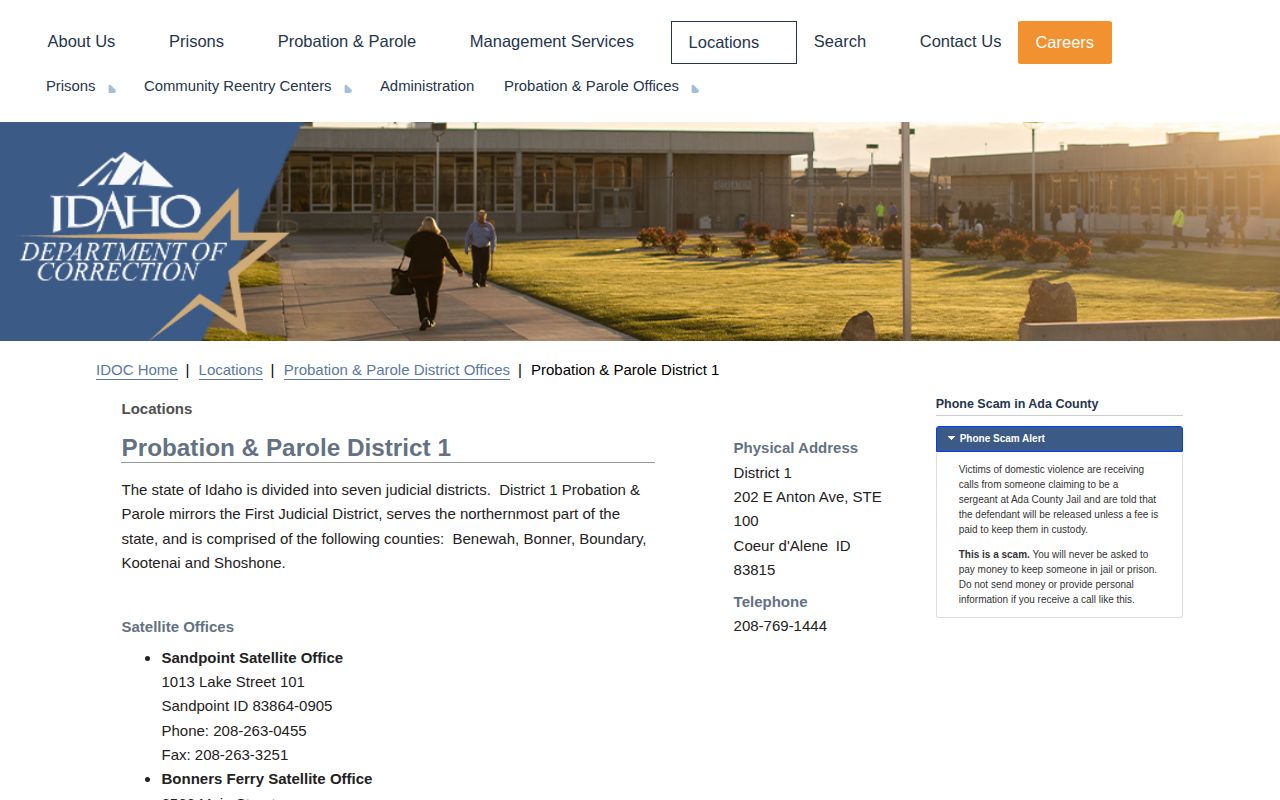
The office listing confirms that Coeur d’Alene is the published District 1 point rather than a Shoshone satellite.
Call with the person’s full name and IDOC number if available. Staff may limit information for safety, privacy, or an active matter. The purpose of the call is to confirm the office and public status, not to obtain a private residence or supervision plan.
Shoshone Warrants and Absconders
Conditions commonly require reporting, lawful conduct, approved travel, and compliance with case-specific directions. A claimed violation does not itself show the final outcome. IDOC may investigate, a court may issue a warrant in a probation case, or the Commission may conduct a parole revocation process. The later public record should be read before treating an allegation as a completed revocation.
IDOC’s Most Wanted and Fugitive Recovery page is selective. It is not a full list of every Shoshone County absconder. A missing name should also be checked in Resident/Client Search, where Active Bench Warrant or parole-violator and probation-violator information may appear. Then confirm the record with District 1 or the court.
Note: A warrant status can change quickly, so preserve the date viewed and confirm it with the agency named in the record.
When Shoshone Supervision Ends
Leaving prison for parole does not end the sentence. The public detail may first show Released to Supervision and later show a sentence satisfaction or discharge date. Likewise, finishing a jail stay does not necessarily end a probation term. “Discharged” means IDOC jurisdiction has ended for the displayed matter, though another case or authority may still exist.
The Idaho Commission publishes hearing decisions, but its parole dates are tentative until required programming, plan approval, and final paperwork are complete. A favorable decision is not an actual release record. After the proposed date, check IDOC for an In community status and the Released to Supervision field. Commission records can be sought through its public-information request route.
Shoshone Diversion Is Not Supervision
Shoshone County’s ILED initiative joins law enforcement, providers, prosecutors, and a jail case manager. Its materials contemplate diversion work and program discharge summaries. That can explain why a case moved from arrest toward treatment or another structured response, but it is not an inmate release database and it does not establish parole or probation.
A physical custody event still needs a sheriff or court record. An IDOC supervision claim needs an IDOC case row and office confirmation. Keeping these systems separate prevents a program discharge from being mistaken for a jail release or an end to a criminal sentence.
Note: Program discharge, jail release, parole placement, and sentence discharge are four separate events and should retain their source labels.
Shoshone Parole Decision Records
The Idaho Commission of Pardons and Parole handles parole hearings and decisions, while IDOC staff supervise a person after release. The Commission’s hearing calendar lists scheduled matters by date, hearing type, name, and IDOC number. A calendar entry means a hearing is planned. It does not show that parole was granted or that the person has left prison. Dates and times can also change, and the hearing order is posted after the prior day’s session closes.
Decision notices appear through the Commission’s hearing and review decisions page. The research found that Notices of Action Taken are generally posted by the Friday after a hearing. A notice may grant a tentative parole date, deny parole, set review or reconsideration, address revocation, or record another action. Preserve that exact disposition. A grant remains conditional on required programming, an approved parole plan, and final IDOC paperwork.
After the proposed date, the IDOC detail supplies the better public check for actual community placement. Look for In community, a case row marked Parole, and a Released to Supervision date. Later discharge is a separate event. Summary minutes that are not already posted can be requested from the Commission’s public-information office.
Shoshone Supervision Status Alerts
Idaho VINE can help track participating custody events, but it is not a complete parole or probation register. A VINE release alert can signal that the person left a jail or prison. It does not state that supervision ended, and it may not explain whether the next step was parole, probation, transfer, or another agency’s custody. The IDOC case row and District 1 confirmation answer the supervision question.
When a person is believed to have violated supervision, use public labels with care. Active Bench Warrant is an IDOC status, while a parole-violator or probation-violator notation may appear at the case level. Neither should be paraphrased as a final revocation without the later Commission or court action. An absconder allegation likewise describes an alleged failure to remain in contact, not a new conviction.
For a probation matter, iCourt can preserve the judgment, later orders, and public register of actions. For parole, the Commission decision and IDOC detail form the stronger chain. Calling District 1 after checking those sources helps resolve stale pages, namesakes, and apparent conflicts without treating one automated alert as the complete record.
Namesakes should be resolved before an office is contacted. Match the IDOC number, birth year, middle name, sentencing county, and case number. A Shoshone County case does not mean the person is physically in Shoshone County, and a listed Shoshone County Jail location does not by itself define the case row as parole or probation. The row label and supervising district carry that meaning.
Public records also have limits. A supervision detail may omit private conditions, treatment information, a residence, or internal case notes. The useful public questions are narrower: whether supervision is active, which type applies, which district is assigned, whether a public warrant status appears, and whether the displayed matter has reached discharge.
A sheriff release response cannot replace those supervision fields. It can establish that a person left Shoshone County Jail and may identify the event or destination. Only the IDOC detail, supervising office, court order, or Commission record can establish the linked post-release status. Using each source for its own role produces a clearer timeline.