
Kootenai Juvenile Release Path
The Kootenai County Juvenile Detention Center is a regional juvenile facility operated by Kootenai County. County minutes documented a housing agreement serving Shoshone County for FY2026. Its presence in this facility list prevents a common search error: a Shoshone County youth may be held outside Shoshone County, but the adult Shoshone County Jail channels do not become the right way to locate that youth.
Where a youth goes after detention depends on the responsible juvenile proceeding and authorized placement. The public adult release categories used for bond, county jail terms, IDOC parole, or adult transfer should not be imposed on a juvenile case. The responsible court and detention agency can identify the lawful process and decide what can be disclosed to an authorized requester. Public silence does not prove release, transfer, or continued custody.
Confirm a Juvenile Release
Use direct, case-specific contact. Do not enter a youth's identity into adult commercial search tools or rely on an adult released-inmate page. Start with the official Kootenai County Juvenile Detention page to identify the facility and its current instructions. If the matter arose in Shoshone County, the responsible juvenile court or an attorney can explain which court has authority and what proof is available.
- Confirm that the matter is juvenile and that Kootenai, rather than an adult jail, is the relevant facility.
- Use the official facility contact and provide only the details needed to locate the case.
- State your relationship to the youth and the reason you are authorized to receive information.
- Ask which court controls the matter and what lawful document, order, or agency confirmation addresses release or placement.
- Follow the court's access rules. Do not infer an outcome from the absence of a public adult result.
The adult Shoshone County release guide remains useful only for understanding why adult systems differ. It is not a juvenile lookup tool. VINELink and IDOC adult results also should not be used to fill a gap in protected juvenile information.
Kootenai Juvenile Records Contact
The official facility page is the safe starting point because contact methods and visitor or family procedures can change. Use its current instructions rather than an adult Shoshone County public-records request aimed at the Sheriff's Office. The adult county form concerns Shoshone County records and does not create access to protected Kootenai juvenile material.
Ask a narrow procedural question: which office handles an authorized inquiry about this specific juvenile matter? A parent, guardian, attorney, or other person with a recognized role may be directed to detention staff, the responsible juvenile court, counsel, or another case agency. Staff must apply privacy and juvenile access rules before disclosing identity, status, placement, or records.
Kootenai Regional Juvenile Role
Kootenai County operates the center as a regional juvenile detention facility. It is not an adult county jail, an IDOC prison, a federal prison, or an ICE detention site. The regional agreement means geography alone can mislead. A case connected with Shoshone County may involve detention in Kootenai County while remaining governed by juvenile procedures.
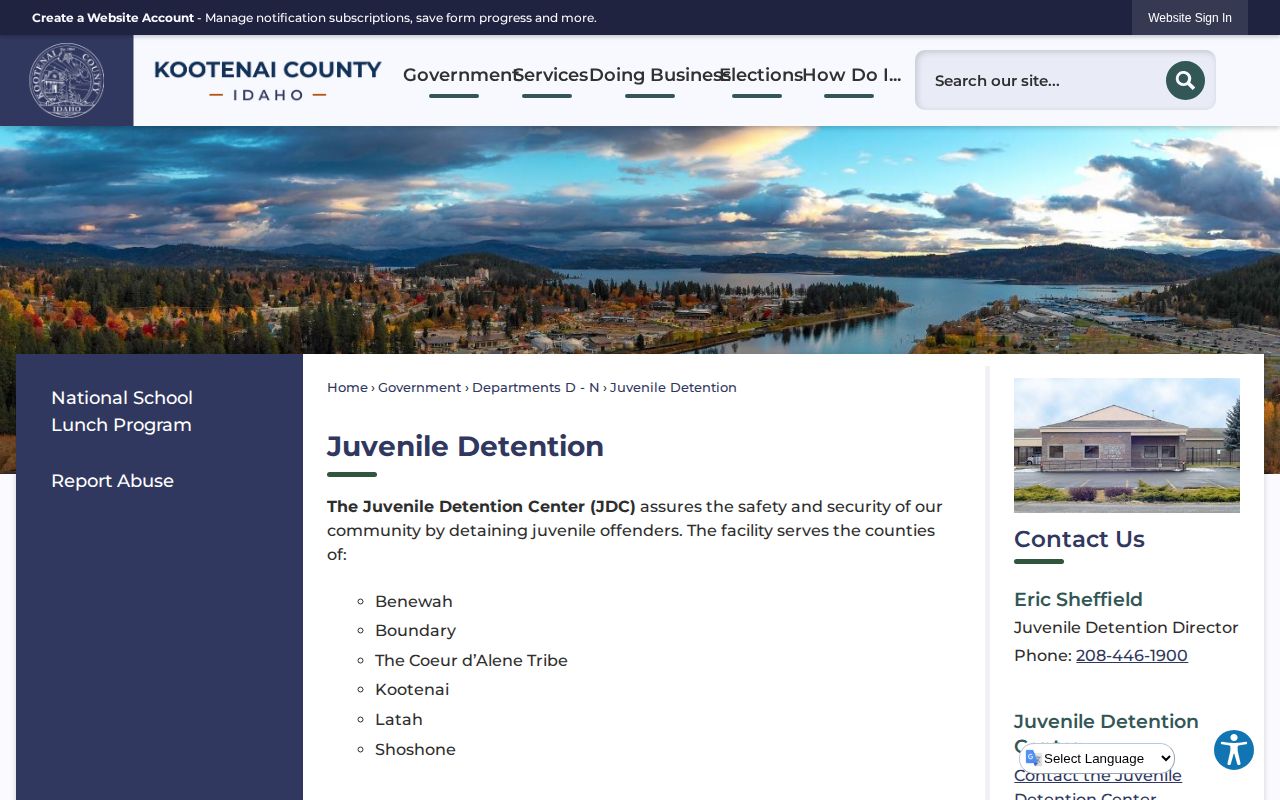
The official facility page pictured below confirms the regional juvenile channel. It should be used to reach current official guidance, not to build a public list of youths.
Keep Adult Searches Separate
Adult Shoshone County channels include the Sheriff's Office, an adult jail custody-event request, Idaho iCourt public case access, IDOC Resident/Client Search, and adult booking summaries. None should be presented as a route to identify a youth. Adult news booking columns are especially unsuitable because the research described them as adult booking summaries, not a release database.
IDOC's public system uses adult corrections terms such as In custody, In community, Released to Supervision, and Discharged. Those labels answer questions within IDOC's system. They do not authorize a conclusion about juvenile detention. Likewise, a blank VINELink or adult roster search does not show that a youth was released.
Juvenile Privacy Boundaries
Juvenile identities, files, and placement details are subject to protections that differ from ordinary adult court and jail records. A public-facing site should not invite broad name searches, publish identifying details, or describe protected case facts. The correct aim is routing an authorized person to the agency or court that can answer within the law.
Even an official court system can restrict juvenile, sealed, warrant, and other protected material. If a public search returns nothing, that result says only that no matching public material appeared. It does not erase the event and does not establish where a youth is. An authorized requester should preserve the case number, court name, and facility contact supplied by counsel or the responsible agency.
Shoshone Juvenile Case Questions
When the underlying matter began in Shoshone County, ask which juvenile court retains authority and whether Kootenai is acting only as the housing facility. Housing and legal authority are different roles. The detention center can address facility procedures within its authority, while the court record or order may control release, placement, or return.
Keep the question exact. Ask whether the youth remains at the facility, whether an authorized release or placement order exists, and which office can provide lawful proof. Do not ask staff to discuss another youth or disclose information beyond the requester's role. If counsel is involved, counsel is often the best source for interpreting an order and coordinating with the responsible agencies.
What Public Results Cannot Prove
No adult Shoshone roster, recent-release list, or public photo gallery was found, but that adult negative finding does not create a juvenile information route. A third-party name result may be stale, copied, misidentified, or outside the case system. It cannot establish a juvenile release.
Use careful wording when documenting an answer. Say that the responsible agency confirmed what it was permitted to confirm, or that the court supplied a particular order. Avoid broader claims about freedom, destination, or case outcome. Another placement, supervision condition, or protected order may remain, and public-facing sources may omit it by law.
Authorized Juvenile Record Requests
Begin with authority, not curiosity. Facility or court staff may need to know whether the caller is a parent, legal guardian, attorney, case professional, or another person recognized in the matter. Be ready to verify identity through the method the agency requires. Share the minimum facts needed to match the case, and do not send sensitive youth information through an unverified address or third-party form.
Ask for the correct custodian before asking for a document. The detention center may maintain facility records while the juvenile court holds orders and case filings. A Shoshone County agency may have referral material, yet Kootenai County operates the regional detention center. Each office can answer only for records it holds and information it is permitted to release. A general adult public-records request cannot override juvenile protections.
If access is denied or limited, request the rule or process that applies and consult counsel when legal interpretation is needed. Do not try to work around a privacy restriction by using adult IDOC, BOP, ICE, registry, news, or commercial data channels. Those systems address different populations and authorities. They can return a namesake, an unrelated adult, or no result at all, none of which resolves the juvenile case.
For a practical confirmation, document the official office contacted, the date, the requester's authorized role, and the exact statement or record supplied. Keep that information private. A narrow record of official communication is more reliable than a broad public search and better respects the youth protections that make this page different from every adult facility page on the site.
A careful answer names the Kootenai County Juvenile Detention Center, the responsible juvenile court, and the authorized event without exposing protected details. If the requester's role does not permit disclosure, the correct result may be a process explanation rather than a public custody record.
Public Record Search
Sponsored Results